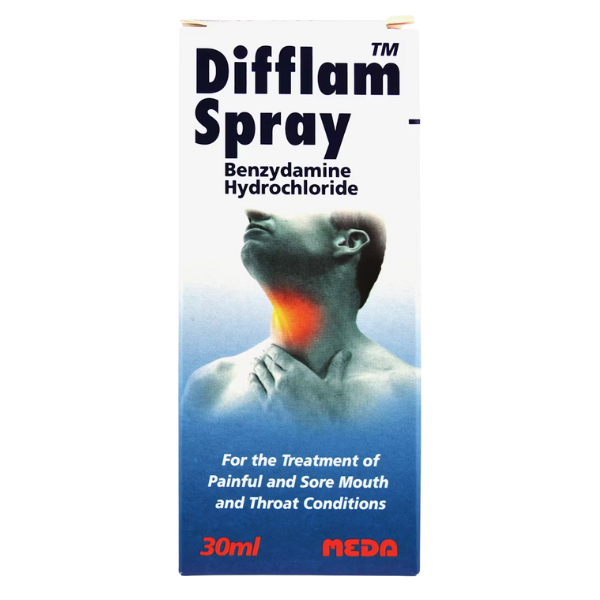
Difflam Spray (30ml)

Locally acting throat spray to relieve pain and inflammation

  • Provides fast-acting relief for sore throats and mouth pain.
  • Contains benzydamine hydrochloride with anti-inflammatory action.
  • Soothes irritation caused by infection or dental procedures.
  • Easy-to-use spray for precise application.
  • Suitable for adults and children over 6 years old.
Strength: 0.15% w/v

£6.79 Available Free Delivery on Orders over £20!

In stock

Overview

How does Difflam Spray biologically reduce inflammation? Difflam Spray contains the active pharmaceutical ingredient benzydamine hydrochloride at a concentration of 0.15% w/v. Benzydamine belongs to a class of medicines known as Non-Steroidal Anti-Inflammatory Drugs (NSAIDs). Unlike systemic NSAIDs (like ibuprofen tablets) that primarily work by inhibiting the cyclooxygenase (COX) enzymes, benzydamine possesses a unique mechanism of action. When Difflam Spray is applied to the throat or mouth, the benzydamine molecules penetrate the inflamed tissues and stabilise the cellular membranes. This stabilisation prevents the release of pro-inflammatory cytokines and enzymes (such as prostaglandins) from the damaged cells. By halting the chemical cascade that triggers the inflammatory response, Difflam Spray effectively reduces the swelling (oedema) and redness (erythema) associated with conditions like tonsillitis or pharyngitis.

What is the local anaesthetic action of Difflam Spray? A critical pharmacological advantage of Difflam Spray is its local anaesthetic (numbing) property. In addition to reducing inflammation, benzydamine acts on the sensory nerve endings in the oropharynx. Biologically, it structurally resembles local anaesthetics, allowing it to reversibly block the sodium channels in the nerve membranes. By preventing the influx of sodium ions, Difflam Spray inhibits the generation and conduction of nerve impulses that transmit pain signals to the brain. This provides rapid relief from the acute “sharp” pain of a sore throat or mouth ulcer, often causing a mild tingling or numbing sensation immediately upon application.

How does the spray formulation of Difflam Spray target oral lesions? Difflam Spray is designed with a long, multi-directional arm nozzle to deliver the active ingredient directly to the site of pain. In conditions like post-operative soreness (e.g., after a tonsillectomy) or radiation-induced mucositis, swallowing pills or sucking lozenges can be mechanically difficult or painful. The atomised spray mechanism of Difflam Spray allows for precise application to the back of the throat or specific ulcers without the need for physical contact or swallowing a solid dose. The formulation includes ethanol and glycerol, which act as co-solvents to ensure the benzydamine is dissolved effectively and can penetrate the mucosal lining (mucous membranes) rapidly to exert its effect.

What specific conditions does Difflam Spray treat? Difflam Spray is clinically indicated for locally treating painful inflammatory conditions of the mouth and throat. This encompasses traumatic conditions such as pharyngitis (sore throat), aphthous ulcers (canker sores), and pain following dental procedures or oral surgery. Difflam Spray is also widely used to manage the discomfort caused by the insertion of dentures. Because it treats the inflammation rather than just masking the pain, Difflam Spray helps to reduce the swelling that often makes swallowing difficult (dysphagia).

Who Is It For

Who is Difflam Spray suitable for? Difflam Spray is suitable for adults, the elderly, and children of all ages. However, the dosing for children is strictly calculated based on weight (see Usage Instructions). Difflam Spray is specifically designed for individuals who find swallowing tablets painful or difficult. It is an ideal choice for patients recovering from tonsillectomies or dental surgery who need targeted, topical relief. Difflam Spray is suitable for use by diabetics as it is sugar-free, using saccharin sodium as a sweetener.

Usage Instructions

How to administer Difflam Spray correctly? Difflam Spray is for use in the mouth and throat only.

Preparation: Lift the folding nozzle so it sticks straight out. Press the green plunger down a few times to prime the pump until a fine mist appears.

Application: Aim the nozzle at the affected area in the mouth or throat. Press the plunger down firmly to release one puff.

Dosage (Adults and Elderly): The recommended dose is 4 to 8 puffs, administered every 1.5 to 3 hours.

Dosage (Children 6-12 years): The recommended dose is 4 puffs, administered every 1.5 to 3 hours.

Dosage (Children under 6 years): The dose is based on weight. Administer 1 puff for every 4kg of body weight, up to a maximum of 4 puffs per dose. This should be given every 1.5 to 3 hours.

Precaution: Avoid contact with the eyes. If the spray enters the eyes, wash them immediately with cold water.

Can I eat or drink after using Difflam Spray? Because Difflam Spray has a numbing effect, users should be cautious when eating or drinking hot foods immediately after use, as the anaesthetic effect might mask the temperature, leading to burns. Additionally, the numbness can theoretically impair the swallowing reflex slightly, so care should be taken.

Warnings

When must Difflam Spray not be used? Difflam Spray must not be used by patients with a known hypersensitivity or allergy to benzydamine hydrochloride or any of the excipients. Although it is applied topically, patients with a history of bronchospasm (asthma) triggered by aspirin or other NSAIDs should use Difflam Spray with caution, as there is a theoretical risk of reaction. Difflam Spray contains a small amount of alcohol (ethanol), which should be considered for patients with liver disease, epilepsy, or alcoholism, although the quantity per dose is minute. Usage during pregnancy and breastfeeding should only occur after consulting a doctor to assess the risk-benefit ratio.

What are the potential side effects of Difflam Spray? The most common side effect of Difflam Spray is a feeling of numbness or stinging in the mouth or throat. This is usually transient. In rare cases, the skin may become sensitive to sunlight (photosensitivity) or a rash may develop. If the throat pain persists for more than 3 days, or if it is accompanied by a high fever or headache, a doctor must be consulted as this may indicate a bacterial infection requiring antibiotics.

Alternatives

Common alternatives to Difflam Spray? If Difflam Spray is not suitable due to the NSAID component or availability, common alternatives include:

Ultra Chloraseptic Anaesthetic Throat Spray: Contains benzocaine, a strong local anaesthetic that numbs the throat rapidly but does not have the anti-inflammatory (swelling reduction) action of Difflam Spray.

Covonia Throat Spray: Contains lidocaine (anaesthetic) and chlorhexidine (antiseptic), providing both numbing and antibacterial action, suitable for infected sore throats.

Strepsils Plus Lozenges: Contains hexylresorcinol (an anaesthetic and antiseptic) in a solid lozenge format, suitable for those who prefer sucking a sweet to using a spray.

Paracetamol or Ibuprofen Tablets: Systemic painkillers that treat the pain and fever associated with sore throats from the “inside out,” often used alongside Difflam Spray for severe pain (checking that the total NSAID dose is safe if using ibuprofen).

Description

Overview

How does Difflam Spray biologically reduce inflammation? Difflam Spray contains the active pharmaceutical ingredient benzydamine hydrochloride at a concentration of 0.15% w/v. Benzydamine belongs to a class of medicines known as Non-Steroidal Anti-Inflammatory Drugs (NSAIDs). Unlike systemic NSAIDs (like ibuprofen tablets) that primarily work by inhibiting the cyclooxygenase (COX) enzymes, benzydamine possesses a unique mechanism of action. When Difflam Spray is applied to the throat or mouth, the benzydamine molecules penetrate the inflamed tissues and stabilise the cellular membranes. This stabilisation prevents the release of pro-inflammatory cytokines and enzymes (such as prostaglandins) from the damaged cells. By halting the chemical cascade that triggers the inflammatory response, Difflam Spray effectively reduces the swelling (oedema) and redness (erythema) associated with conditions like tonsillitis or pharyngitis.

What is the local anaesthetic action of Difflam Spray? A critical pharmacological advantage of Difflam Spray is its local anaesthetic (numbing) property. In addition to reducing inflammation, benzydamine acts on the sensory nerve endings in the oropharynx. Biologically, it structurally resembles local anaesthetics, allowing it to reversibly block the sodium channels in the nerve membranes. By preventing the influx of sodium ions, Difflam Spray inhibits the generation and conduction of nerve impulses that transmit pain signals to the brain. This provides rapid relief from the acute “sharp” pain of a sore throat or mouth ulcer, often causing a mild tingling or numbing sensation immediately upon application.

How does the spray formulation of Difflam Spray target oral lesions? Difflam Spray is designed with a long, multi-directional arm nozzle to deliver the active ingredient directly to the site of pain. In conditions like post-operative soreness (e.g., after a tonsillectomy) or radiation-induced mucositis, swallowing pills or sucking lozenges can be mechanically difficult or painful. The atomised spray mechanism of Difflam Spray allows for precise application to the back of the throat or specific ulcers without the need for physical contact or swallowing a solid dose. The formulation includes ethanol and glycerol, which act as co-solvents to ensure the benzydamine is dissolved effectively and can penetrate the mucosal lining (mucous membranes) rapidly to exert its effect.

What specific conditions does Difflam Spray treat? Difflam Spray is clinically indicated for locally treating painful inflammatory conditions of the mouth and throat. This encompasses traumatic conditions such as pharyngitis (sore throat), aphthous ulcers (canker sores), and pain following dental procedures or oral surgery. Difflam Spray is also widely used to manage the discomfort caused by the insertion of dentures. Because it treats the inflammation rather than just masking the pain, Difflam Spray helps to reduce the swelling that often makes swallowing difficult (dysphagia).

Who Is It For

Who is Difflam Spray suitable for? Difflam Spray is suitable for adults, the elderly, and children of all ages. However, the dosing for children is strictly calculated based on weight (see Usage Instructions). Difflam Spray is specifically designed for individuals who find swallowing tablets painful or difficult. It is an ideal choice for patients recovering from tonsillectomies or dental surgery who need targeted, topical relief. Difflam Spray is suitable for use by diabetics as it is sugar-free, using saccharin sodium as a sweetener.

Usage Instructions

How to administer Difflam Spray correctly? Difflam Spray is for use in the mouth and throat only.

Preparation: Lift the folding nozzle so it sticks straight out. Press the green plunger down a few times to prime the pump until a fine mist appears.

Application: Aim the nozzle at the affected area in the mouth or throat. Press the plunger down firmly to release one puff.

Dosage (Adults and Elderly): The recommended dose is 4 to 8 puffs, administered every 1.5 to 3 hours.

Dosage (Children 6-12 years): The recommended dose is 4 puffs, administered every 1.5 to 3 hours.

Dosage (Children under 6 years): The dose is based on weight. Administer 1 puff for every 4kg of body weight, up to a maximum of 4 puffs per dose. This should be given every 1.5 to 3 hours.

Precaution: Avoid contact with the eyes. If the spray enters the eyes, wash them immediately with cold water.

Can I eat or drink after using Difflam Spray? Because Difflam Spray has a numbing effect, users should be cautious when eating or drinking hot foods immediately after use, as the anaesthetic effect might mask the temperature, leading to burns. Additionally, the numbness can theoretically impair the swallowing reflex slightly, so care should be taken.

Warnings

When must Difflam Spray not be used? Difflam Spray must not be used by patients with a known hypersensitivity or allergy to benzydamine hydrochloride or any of the excipients. Although it is applied topically, patients with a history of bronchospasm (asthma) triggered by aspirin or other NSAIDs should use Difflam Spray with caution, as there is a theoretical risk of reaction. Difflam Spray contains a small amount of alcohol (ethanol), which should be considered for patients with liver disease, epilepsy, or alcoholism, although the quantity per dose is minute. Usage during pregnancy and breastfeeding should only occur after consulting a doctor to assess the risk-benefit ratio.

What are the potential side effects of Difflam Spray? The most common side effect of Difflam Spray is a feeling of numbness or stinging in the mouth or throat. This is usually transient. In rare cases, the skin may become sensitive to sunlight (photosensitivity) or a rash may develop. If the throat pain persists for more than 3 days, or if it is accompanied by a high fever or headache, a doctor must be consulted as this may indicate a bacterial infection requiring antibiotics.

Alternatives

Common alternatives to Difflam Spray? If Difflam Spray is not suitable due to the NSAID component or availability, common alternatives include:

Ultra Chloraseptic Anaesthetic Throat Spray: Contains benzocaine, a strong local anaesthetic that numbs the throat rapidly but does not have the anti-inflammatory (swelling reduction) action of Difflam Spray.

Covonia Throat Spray: Contains lidocaine (anaesthetic) and chlorhexidine (antiseptic), providing both numbing and antibacterial action, suitable for infected sore throats.

Strepsils Plus Lozenges: Contains hexylresorcinol (an anaesthetic and antiseptic) in a solid lozenge format, suitable for those who prefer sucking a sweet to using a spray.

Paracetamol or Ibuprofen Tablets: Systemic painkillers that treat the pain and fever associated with sore throats from the “inside out,” often used alongside Difflam Spray for severe pain (checking that the total NSAID dose is safe if using ibuprofen).

Additional information

Size

Strength